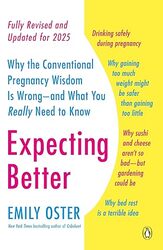
Rating: 7.8/10.
Book by an economist trying to make sense statistics about what to do during and after pregnancy, based on studies in the medical literature. She tries to be as evidence-based as possible, sometimes going against convention when the studies show otherwise. Much of the time, the evidence is weak due to the difficulty of doing proper experiments on humans, which is expected, but in some cases there is strong evidence in one direction or another that would be good to be informed.
The recommendation that small amounts of alcohol are not harmful is the most controversial part of the book, contradicting some public health guidelines, which generally say that no amount of alcohol is safe during pregnancy, whereas the book recommends that only heavy drinking is harmful. This stems from differing interpretations of the studies, which are lacking in strong evidence that light drinking is harmful – public health guidelines tend to be more conservative, whereas this book emphasizes individual freedom and autonomy to make your own decisions.
Age of fertility – fertility continuously declines, and being pregnant after age 40 is still common, with 35 not being a cutoff; obese mothers tend to have more issues. Contraception is possible only during about a five-day period before ovulation, which is around 10 to 15 days after the period (detectable retroactively through temperature or testing). A pregnancy test can detect quite early, but miscarriage in the early phase is common, so it is perhaps better not to do the test.
How different types of substances affect pregnancy. For alcohol – it seems that light drinking is not harmful, as long as it is less than one drink a day, despite the stigma surrounding it in America, but heavy drinking is detrimental. For caffeine, up to two cups presents no issue, but there is mixed evidence concerning higher amounts. For tobacco use, even moderate use is bad for the baby; for cannabis, studies are limited, but it is probably not good.
Miscarriage is most common early in pregnancy and is usually due to chromosomal issues that cannot be controlled, with the risk dropping significantly after 12 weeks; Older women and those who use IVF are more likely to miscarry.
Random things are connected to pregnancy issues, but the studies tend to be negative and only show small effects at very high doses, eg: cat litter, gardening, hot temperatures, and radiation from air travel fall into this category. However, illnesses do seem to be more harmful for pregnant women than for the general population, but usually it’s not clear how to avoid them except to see doctors sooner rather than later and take vaccines when available. Food poisoning tends to be more harmful in pregnant women, so it’s a good idea to avoid some foods like raw meat and eggs. Some fish are high in mercury (toxic), whereas others are high in helpful omega-3 nutrients but it takes some research to determine which fish are good and bad.
Screening for chromosomal disorders (mainly Down syndrome) can be done in a quick and non-invasive way or an invasive way with more accuracy. The non-invasive test is quite accurate, but false positives and negatives are possible. The invasive method is more accurate but has a small risk of hitting the baby, causing a miscarriage. So whether to take it or not depends on how you feel about losing a baby versus having a chromosomal defect.
Nausea: A moderate amount of nausea is expected. Women experiencing no nausea at all are more likely than average to have issues. It tends to peak at six to eight weeks, and a minority get much more than average, which is dangerous if untreated. Effect on weight gain versus baby health – more weight gain is associated with larger babies. Both too large and too small can be bad, but there are more complications if the baby is too small than vice versa.
The gender of the baby can be determined fairly accurately around 15 to 20 weeks through various tests, and it’s also possible to control the gender using some advanced biotechnology. Most exercise is fine during pregnancy as long as the baby doesn’t get injured; some exercises like Kegels help with urinary incontinence, and yoga is beneficial. You’re likely to get less sleep during later stages, and taking sleeping aids is fine.
Drug safety: drugs are classified into categories A, B, C, D, and X based on safety during pregnancy. A and B have strong evidence of safety, and D and X have evidence of causing harm. There is a large category C with many drugs where the evidence is either weak or missing, so you have to do your own research.
Medical advances have made it so that as early as 28 weeks, premature babies have a high survival rate, although some developmental disorders are likely. It’s possible to measure the baby’s size either physically or with an ultrasound, but neither is very accurate. Certain conditions can make a high-risk pregnancy, and likely the same conditions persist between multiple pregnancies. However, there are many possible uncommon conditions, so it’s best to consult your doctor rather than this book.
The chance of birth each week is around 50% after the 39th week, which is the most common pregnancy length. A doctor will usually induce birth by 42 weeks and can check the cervix for signs of delivery soon.
There are several stages of labor, with dilation and then pushing. There are statistics on average length for each phase, but these can vary several times in either direction depending on the woman. Labor induction can be recommended as early as 37 weeks if the fluid measurements seem low or the baby seems non-responsive. However, many of these tests are inaccurate (eg, the baby may just be sleeping) and too early of an induction that’s not necessary can be harmful.
C-section should not be the default choice because the time to heal is longer than a natural birth, but there is no long-term effect. This is often recommended if the baby is in a position other than head-first (breech or other positions), and it tends to be required for later births if the previous one was a C-section. An epidural is a strong pain relief option and most mothers choose it. There’s no negative effect for the baby, but there are a bunch of potential complications for the mother which lengthen recovery. It’s possible to try without it and get it later when required.
If the water breaks, labor is likely to start soon, but it’s not necessary to go to the hospital immediately. Eating during labor is not recommended due to vomit risk. It’s recommended to have a doula through the whole process, not to do continuous monitoring with a machine, and don’t do an unnecessary episiotomy cut to the vagina. May be better to delay cutting the cord a few minutes, and the cord blood may be donated since it contains stem cells, but it’s probably not worth the cost to store it for yourself.
Home birth is relatively uncommon but a possible alternative to going to the hospital. It may be more comfortable, but you are further from medical care if something goes wrong, and around 30% of the time you need to go to the hospital anyway. If going down this route, then having an experienced midwife is recommended.