Rating: 7.8/10.
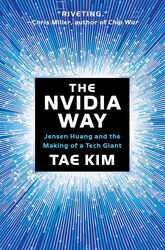
Book covering the history of NVIDIA, one of the most successful tech companies of our time. The CEO Jensen Huang had founded NVIDIA and run the company from the beginning, and the company had many failures before its eventual success. He encourages healthy disagreement and constantly worries about complacency and falling behind, which can happen to any company even if it’s successful.
Jensen Huang was born in Taiwan and Thailand and moved to a US boarding school at age nine. He studied electrical engineering and started working at AMD; meanwhile, Curtis Priem and Chris Malachowsky were employed at Sun Microsystems. They worked with Jensen Huang, who was at LSI, and together they designed a successful graphics card for an aviation game in 1991. Then Sun became too bureaucratic, so together they decided to leave.
In 1993, the three of them quit to found NVIDIA and got some senior engineers to join as well, and managed to raise Series A from Sequoia without a product yet or a business plan, just from their technical credentials. Their first launch, NV1, was a flop as it was too ambitious with a new standard and attempted to do both audio and video, but it didn’t attract enough software support and couldn’t run mainstream games very well. The company laid off most of its staff and had very limited runway, and decided to bet on software emulation in order to get to market a year faster than usual. It released the RIVA 128 card in 1997, and this card beat competitors on benchmarks and immediately got a lot of attention and sales.
The RIVA 128 saved the company from bankruptcy. Jensen was fiercely competitive and expected things to be done as fast as physically possible, for employees to work long hours and weekends as well. They partnered with TSMC after the previous manufacturer failed to deliver, and innovated on emulation techniques to iterate on hardware faster. Eventually, Nvidia outexecuted competitors like 3dfx and SGI and went public in 1999. They tried aggressive marketing, like giving out free cards to integrators, and won deals with Microsoft. Priem resigned after not getting along with the company and trying to force things to be done his way. They fended off competition from below by selling cards with slight defects as lower-tier cards rather than discarding them, and entered into an agreement with Apple to supply their laptops.
They invented the programmable graphics pipeline, but they released the NV30, which was a failure with poor performance and loud fans because the hardware and software teams often lacked proper communication. Soon after the release of the programmable graphics pipeline in the early 2000s, the community figured out how to use GPUs for non-graphics applications like scientific computation, or GPGPU. Nvidia quickly invested into CUDA to make scientific computing easier. While the market was skeptical of the idea, they sponsored education for the new technology and made it available on all their GPUs. By the time the technology was widely realized to be useful in the 2010s, they were already years ahead.
Nvidia’s management principles after growing large include giving feedback publicly rather than privately so that others can learn from it, even though it might be embarrassing, and maintaining a flat and flexible organization without too much management and a whiteboarding culture over PowerPoint slides. Jensen Huang remains very technical for a CEO and expects long hours to stay ahead, even as the company is already successful, and warns against complacency where non-technical CEOs like Microsoft and Intel miss the next big trend and struggle to catch up later.
In 2012, deep learning had its ImageNet moment, where scaling its training on multiple GPUs for the first time led to a breakthrough in image recognition accuracy. Nvidia immediately capitalized on this advancement, rushing to incorporate AI features in its Volta chips. They acquired Mellanox, creator of InfiniBand, in 2019 for $6 billion as a foundational networking technology. Nvidia continues to innovate with ray tracing for video games in 2018, and this did not exist before but quickly gained traction after it was introduced. Nvidia is now dominant in AI chips as models get bigger. The reason is that it’s good at recognizing early signs of a new technology like transformers and investing massively in it so that they are always ahead by the time the idea reaches mainstream adoption. Even though the company has grown massively, Huang is still deeply involved in enforcing the company’s culture, making sure that the company continues to innovate and move quickly.