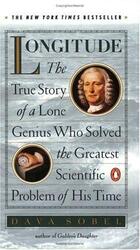
Rating: 7.8/10.
Fairly short book (175 pages) about the marine chronometer, one of the most famous books in the genre of short book about a specific object. It first also lays out the problem of determining longitude: whereas latitude is easy to determine at sea just by observing the position of the sun, longitude requires knowing the precise time at home, and this couldn’t be determined reliably in the early 18th century. Numerous accounts of sailors being lost at sea and not knowing their position, one example being a fleet of warships running into the Scilly Isles of the British Isles and losing several ships, and another being a ship off the coast of Chile taking weeks to find the island of Juan Fernandez without knowing whether it was east or west of where they were.
Various mechanisms were tried to fix the longitude by reference to celestial bodies, where some event occurs at the same time everywhere, and eclipses were one way, but they were too rare. Tracing the moon’s trajectory through the stars was a proposed idea, but prior to the theory of gravitation, nobody could predict it accurately enough. Galileo had a method of observing Jupiter’s moons through a telescope, and it worked on land but was infeasible on a ship. At the time, many crackpots also tried to propose various mechanisms, like involving injuring a dog, or using magnetic versus celestial north pole, or even stationing a bunch of ships at regular intervals across the ocean, anchored at precise points and setting off fireworks. This was the background against which a reward was issued in 1714 for a method to be able to determine the longitude to various degrees of accuracy, and it was unclear whether the solution would be an accurate clock or a different method, since Newton thought that more accurate astronomy was the more promising direction.
At this point in the story is where the protagonist, John Harrison, enters the story. He is self-taught and learns how to make clocks without any kind of apprenticeship, and he makes one that is accurate to a second per month, much more accurate than other clockmakers at the time. With his first machine, the H1, Harrison goes to claim the longitude prize. He passes the test, but gets asked to do a second, larger trial run across the Atlantic, although he himself tends to get seasick. Around the same time as Harrison’s work, in the 1730s, Halley and other astronomers had good enough models of the moon’s path to derive longitude, although this requires doing a bunch of math and skill with instruments. However, the trade-off was that Harrison’s clock was very complex and difficult to manufacture, and the board was not sure how repeatable this process was. Harrison iterates on the clock for over a decade, and the last iteration is the H4, which was the one that completed the Atlantic voyage with the required accuracy. However, Harrison was not awarded the prize because his rival, Maskelyne, determined the criteria for the prize and was also a main proponent of the astronomical method of using the lunar tables, which was therefore a clear conflict of interest.
Harrison was forced to divulge the details of his mechanisms to claim the prize, and the details spread around openly within the community. Maskelyne being the villain in the story, orders Harrison’s clocks to be seized from his house, allegedly damaging one of them in the process. The board then asks for reproducibility, so Harrison gets Kendall, another clockmaker, to create the K1, which took another two years but was used on Cook’s voyage. After Harrison’s death in 1776, his successors were able to improve the mechanism, making it cheaper and more reliable. It takes a few more decades for clocks to become common on sea voyages. Nowadays, the H1 to H3 are restored and actually running in a museum in Greenwich, which was adopted internationally as the zero point for longitude, and the H4 is static, having been determined to be no longer runnable.
Overall, a quick read with a compelling narrative with a clear protagonist and antagonist. Its weakness is that it glossed over any technical details about the mechanism, how his clocks worked, and how they were able to solve the problems that pendulum clocks had; these were skipped over. Also, some real defects of the story about the mechanism were swept under the rug as well, such as the difficulty of producing and operating it: in the story, Harrison is portrayed as a genius who was unfairly denied the prize.