Rating: 8.3/10.
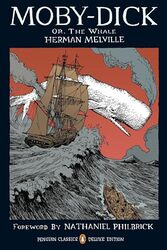
Fairly long classic American novel set in about 1840, about hunting a whale Moby Dick (the whale’s name, which is the title of the book) – it is quite dense but still doable to read with some help from references. It is broken into over 100 very short chapters, ranging from just one page to rarely more than five or six pages each, and the style shifts constantly from one chapter to the next. The beginning reads like a fairly normal adventure story where the protagonist, Ishmael, arrives at the town of New Bedford, and he is forced to share a bed with Queequeg, an islander with tattoos that he finds scary and is rumored to be a cannibal and described as half civilized. But soon they become friends, and Queequeg proves to be a skilled harpooner and demonstrates his strength, and they embark on a whaling voyage together, and negotiate the pay for both.
After the ship sets sail, the plot basically stops for the next 400 pages, and instead the chapters talk about various people on the ship (manned by about 30 people), and every conceivable angle about whales, their history, how they are perceived in different cultures. There is a chapter that classifies all the whale species by book sizes, followed by a Shakespearean-like play where the crew members celebrate, and a few chapters later, a story within a story about a sailor who revolts against his captain who was then killed by a whale, etc. Every possible tangent imaginable about whales is in one of these chapters, as a narrator who spends many months at sea, often with not much happening, and his mind wanders, ponders and rambles around whatever he may be thinking about, but always connected to the topic of the whale.
A few weeks into the voyage, we meet Captain Ahab, whose entire purpose is personal revenge: to hunt the whale – Moby Dick – which, in a previous voyage, had taken his leg, so now his leg is a piece of whale bone that’s fastened to his leg by a carpenter. At the same time, the rest of the crew is mainly motivated by wealth: whale oil, which is used to produce light back in that time before petroleum. To motivate his crew, Ahab nails a golden doubloon to the mast as a reward to whoever is the first to spot Moby Dick. To form an analogy to a tech startup, Ahab would be the highly ambitious and egotistical founder with a crazy and personal vision; as a counterweight to Ahab is his officer Starbuck, who is a more cautious type, someone who reins him back a bit, but Ahab has the final say. The whole arrangement is quite similar to a tech startup, given the risk of the venture, and everybody is paid in “lays” (fraction of the profit), rather than salary, with Queequeg getting a much higher share than the narrator.
Some of the most interesting chapters are about the process of hunting and processing the whale: first getting into boats, lowering them, and surrounding the whale, and hitting it with harpoons multiple times; sometimes the small boats are dragged at a fast pace as the whale tries to escape. Once it has been killed, they use ropes to tie it to the side of the ship, then it is cut up. The most valuable part is the oil inside the whale’s head, spermaceti, stored in a special chamber. The blubber is used to make oil; whale meat can be eaten for food but is marginal; ambergris from the intestines can be collected as perfume (which the narrator notes ironically). The processing of the whale into oil is done in the try-works, of boiling the blubber and then putting it into casks and storing it below in the ship’s hold, before the crew goes on a cleaning operation to remove all the oil from the deck. These chapters show a lot of research and lived experience, since the author worked on such a vessel before writing the book. It’s accurate documentation of how the industry worked, a trade which was dead just a few decades later.
Interspersed between these factual chapters are ramblings about each part of the whale’s anatomy, going part by part, like its head, its tail, its blowhole, each treating the animal with an almost religious reverence, as something to be worshipped, mainly amazed by the size of the creature, its strength, and its infinitude, and how it lives for such a long time, has existed for so long. The narrator predicts that it cannot be hunted to extinction because there are so many of them compared to mankind.
Several times they meet another ship and have an exchange known as the “gam”, where they stop for some time and the officers go across to the other ship and exchange news and letters and have some conversations. The first few are pleasant and describe the procedure and conventions of such an encounter at sea; there is one where the officer Stubb tricks a French ship into cutting loose a whale that they had collected and that was stinking. On the later encounters, Ahab is increasingly impatient and just wants to know the whereabouts of Moby Dick and reach him as quickly as possible.
Among the many chapters, there are several more memorable events that happen at sea, including an episode where a boy, Pip, gets tangled in ropes and falls overboard, and floats in the sea for a few hours before being rescued, and speaks incoherently for the rest of the book. There is also the harpooner Tashtego, who somehow falls into the sperm whale’s chamber and almost drowns until he is rescued by Queequeg. There are multiple chapters where they talk about their views on life and their motivations for the trip, some with Ahab and the officers, and some where he is talking philosophically to the carpenter while he works (but doesn’t get much of a response back). Near the end, Queequeg gets ill and orders a coffin, which eventually becomes the object that saves the narrator’s life.
The ending is fairly short. They finally spot Moby Dick in the last 30 pages of the book and go on a three-day hunt to try to catch him. Moby Dick proves to be too strong and escapes twice, and on the third attempt, he destroys the ship, and everybody drowns except for the narrator, who clings onto the coffin until he is rescued by one of the previous ships. Overall, it is quite a dense but varied book and doesn’t really fit the structure of a novel, since not much is happening plot-wise for so much of it, but rather several quite different threads are intertwined among each other. Although I read it slowly across a month there is quite a lot of detail in each chapter that I needed some help to interpret, and probably only picked up on a fraction of what is there.