Rating: 8.8/10.
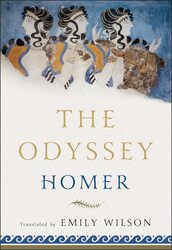
An ancient Greek epic poem by Homer, I got this book after seeing Christopher Nolan’s Odyssey movie, which is a fairly accurate rendition (at least of the main characters and events). Overall, I found this much more enjoyable and easier to read than the Iliad, the other great Homeric epic poem, due to a combination of knowing the story through the movie already, a more modern translation, and also the story just overall being easier to follow. Emily Wilson’s translation from 2017 is fairly plain and straightforward to read, with modern language rather than archaic English, and uses iambic pentameter. It matches the original line by line, but uses relatively fewer words, so it reads faster than most translations of this work.
Books 1-4 start with Telemachus, the son of Odysseus. At this time, Odysseus had been gone for 20 years; the god Athena tells Telemachus to search for his father, and he gets a group of men to travel around and talk to several of Odysseus’s old friends Nestor and Menelaus, who talk about the adventures in Troy and how King Agamemnon was betrayed, but they don’t know the exact whereabouts of Odysseus. Meanwhile, suitors are waiting to marry Penelope, Odysseus’s wife, to inherit his kingdom, and they plot to kill Telemachus before he arrives back home.
In Books 5-8, we finally turn to the main character Odysseus, who starts off at Calypso’s island, where the gods ask him to build a raft and set off, and he survives a storm before ending up on the shores of the Phaeacians, who welcome him and give him a feast where he starts telling the story of Troy and how he ended up there.
Books 9-12 are the most action-packed, telling of the cave of the Cyclops Polyphemus eating his men, who he tricked with the “No Man” maneuver and by hiding under his sheep, his men losing more men to the giant Laestrygonians, the island with witch Circe who turns them into pigs, visiting the land of the dead where he hears from various spirits of soldiers who died, his mother, Agamemnon, Achilles, etc, then the tales of the Sirens and Scylla killing more men, and how his men disobeyed him to kill cows for food, and how he washed up on Calypso’s island after the storm.
In Books 13-16, he returns to Ithaca disguised as a beggar from Crete and meets with his former loyal slave, who knows Odysseus and believes that Odysseus will soon return. Overall, these are fairly quiet chapters where not too much happens; Telemachus arrives back home and Odysseus reveals himself to him and they start making a plot to deal with the suitors, and this is when the action picks back up.
Books 17-23 have Odysseus approach the suitors while still in disguise and get taunted by suitors like Antinous and Eurymachus; he disguises himself even to his wife, until they arrange an archery contest with stringing a bow and shooting through axes gets to marry Penelope. Only Odysseus is able to complete the challenge, and his men slaughter all of the suitors in a large battle, and they hang all of the slave girls that they were associated with, and he finally reveals who he is to Penelope. Chapter 24 is a sort of epilogue where we hear from the killed suitors in the afterlife, and Odysseus continues fighting in his kingdom.
Wilson writes a lengthy introduction (about 80 pages), in summary: the work was composed by Homer in the 8th century; it’s unclear if there was one or multiple authors, and this time was the first adoption or adaptation of oral tradition after writing was first available, and it combines the mythical with the contemporary world; the text was fairly stable by classical Greek times.
Odysseus is mainly portrayed as clever and cunning, a sort of raider or pirate, his willingness to trick others and deceive is a strength and the poem’s opening line describes him as polytropos, literally of many twists and turns and figuratively his shifty and cunning nature, and which Wilson translates as “a complicated man”. This is quite different from Nolan’s movie, where Odysseus is burdened by guilt for what he has committed to others. The movie conveniently omits the needlessly cruel final act of hanging all the slave girls.
An interesting aspect is “xenia”, the visitor-host ritual of feeding the guest before asking their origins, and then sending them off by providing resources for them to go on. This sequence is repeated several times, and protagonists always follow this sequence whereas enemies violate it in different ways. Gods appear in various disguises and intervene in human events, especially Athena.
Women’s loyalty to their husband is treated as central, whereas infidelity in men is less serious, such as Odysseus’s seven years with Calypso or flirting with Nausicaa. Penelope is about equally as clever and tricky as Odysseus, with her weaving and unweaving of the shroud; the poem makes her true feelings unclear. Telemachus grows up partially but not completely, and likes to assert over his mother as a form of status, but is not fully adult-like because in the poem’s logic, the man of the household needs to remain Odysseus. The poem was widely read in the Greek world and was adapted by ancient authors like Virgil into Latin. Greek knowledge was lost for many centuries in Western Europe until the Renaissance, when it became available again and was then adapted by Milton, Joyce, and multiple modern versions.